by Tom O'Hare | Mar 11, 2023 | Before, College Admissions, College Planning, College Readiness, Financial Aid
Recently I spoke with an employee group as part of an educational enrichment program attended by parents of high school and college-age students. We talk about the classic nuts and bolts, managing deadlines, scheduling campus visits, the application processes, and how to pay for college. All are part of the responsibilities parents must oversee as they navigate selecting their students (families) right education pathway after high school.
As the meeting started to break up, a few parents voiced their frustration, some even saying they might have a better chance throwing a lucky penny into a fountain than getting their kids into school and being able to afford it. I looked at the session organizer and asked if we could extend the lunch and learn for those who wanted to continue.
For the next twenty minutes, we discussed the importance of planning, with a twist – it’s time to understand and recognize the wild vortexes families can get drawn into, willingly and unknowingly – why – because we allow ourselves. Parents must rethink their approach to education, work, and careers after high school by first accepting that the system has created some significant pitfalls.
Six Vortexes To Avoid
- Emotions – we hope we follow a natural thought process. Still, once our son or daughter gets their hope up, it becomes emotionally driven, and things like the right choice and our financing capabilities get thrown out the window.
- Financing Realities – after purchasing a home, investing in college is the most expensive life change event in a family’s life. So why do educators, financial planners, and other advisers position families to focus on paying for college incorrectly? Knowing if we can afford the cost is paramount to how we help our students find their authentic education path in high school. Financing first – shopping for the beautiful campus is second.
- Vanity and Prestige – for some psychological reason, we worry about what our neighbors, relatives, and friends think about the choices we hope our students (family) will make. Are they paying the bill? Are they losing sleep over the agonizing process? Do they really know your student – truly. Or is it some misguided reality game we are allowing ourselves to be playing? Why?
- First Generation – like having a child (I have four), first-time high school and college-age families have questions and need help. Even if you are a veteran college parent, without practical and experienced-based guidance, you can get overwhelmed with stress and anxiety. Always ask why? How come, and can you help me? Knowledge is power!
- Poor Communication – there is a massive gap in the flow of information. School systems expect students to communicate vital information to their parents – NOT! Parents with questions or inquiries must seek answers, not wait for meetings. Living in the dark is another primary source of stress and anxiety.
- Peer Pressure – what 17-year-old will raise their hand and proclaim, no, I’m not following the herd; I’m going to do my way? Education to career planning post-high school is no longer a one-fits-all process. Helping students step out of social media’s shadows and peer pressure to find their authentic self takes courage. Celebrate the student-athlete, the skilled trade professional, the academic dancer, and the community college learner on the same level.
Starting Point – Just One
- Goals and Expectations – if you are a parent of a high school student and have not discussed four critical topics, then get at it – start helping them shape their future – ask:
- What are your strengths, skills, and experiences – in and out of school
- Who do you balance a checkbook, calculate compounding interest and be financially literate
- What are you interested in, values, hobbies, ideas, and the occasional job, and
- What do they like their life to look like? What hopes, dreams, and lifestyle preferences
We ended the intense and highly energetic session with the need to keep talking. Everyone had to go back to work. I shared my number – the office door is always open.
A reminder – this is an emotional process with many peaks and valleys for their students and themselves. And yes (I beat a dead horse), proper planning and asking (not waiting) for guidance, advice, and help will make the journey much more enjoyable.
Ben Franklin once said, “Failing to prepare is planning to fail” The college search, selection, and payment process can be a long, sometimes consuming experience. Understanding the twist and turns, rules of the road, and how they apply to you and your students are crucial to surviving the journey. Need help with your plan? Schedule a free consultation to learn how we are helping students and parents. Text or call 617-240-7350 or email tom@getcollegegoing.com. Learn more at www.getcollegegoing.com
Our four pillars at Get College Going: find the right education pathway, for the right reason, at the right school, at an affordable cost
by Tom O'Hare | Oct 9, 2022 | College Admissions, During & After - Just Thinking, Financial Aid
October is a month when a lot of things begin to happen. We welcome the arrival of crisp air, pumpkins, and earlier sunsets in the Fall. I look forward to Halloween, football under the lights, college fairs, and adding a vest to break the chill.
For families of high school students, especially those in 11th grade, October ushers in the thought of planning for post-high school, the 13th year. College, work, apprenticeship, or a combination. Twelve-grade families, it is an all-hands-on-deck push to complete applications, admission, and financial aid with an eye on September of 2023. For parents of college-age students, October is a time to check in on first marks and adjustments to being away.
Last month I took you into the weeds of this important to the college planning process. This month we’re looking at dates, deadlines, and events on the October calendar.
DATES
Wednesday, October 12th – PSAT Test Day
The preliminary SAT and National Merit Scholarship Qualifying Test (PSAT/NMSQT) is administered nationally on one Wednesday in October. High schools work with the College Board to administer the test in Massachusetts and across the six-state region. Scanning a sampling of MA, NH, and ME high schools, students will take the PSAT on Wednesday, October 12. All students are encouraged to take the test to set a benchmark for future testing and as a qualifier for the National Merit Scholarship. Check with your high school to confirm the date for your school system. Homeschooling families are eligible to sit for the test at the town/city high school. Note: Saturday, October 15th is an alternative date
Saturday, October 1 – FAFSA Application Opens
The Free Application for Student Aid (FAFSA) is the universal application that ALL students and families considering attending or returning in September of 2023 must file to be eligible for need-based financial aid. Whether a student is considering undergraduate, graduate, a 4YR college or university, Community College, or a qualified trade and professional school, completing and filing the FAFSA is a must. We have published a FAFSA Checklist outlining the steps to take and the information required to complete the application in the Resource section of our website. It only takes 45 minutes to complete – Don’t leave valuable financial aid on the table.
Download a copy of the 2023-2024 FAFSA Checklist get started.
November 1st | 5th | 15th – Early Action Application Deadlines
Students planning on submitting their application for admissions using the Early Action timeline should be working to gather all necessary documentation to meet the deadline. Check with your specific college for admission requirements and dates. Be aware, I am not an Early Decision advisor. It limits choice and technically is a binding agreement process. Early action accomplishes the same, early consideration but without the stress of a binding agreement. Regular admission deadlines are in January and February. To be ready, you need:
⊗ Fully Loaded Application – the Common Application or school specific app
⊗ Dashboard loaded with school choices
⊗ Authentic well written essay
⊗ Responses to school specific Supplemental Writing (Questions)
⊗ Recommendations
⊗ High School Resume (if wishing to upload)
⊗ Fee Waiver – if eligible
⊗ Credit Card – pay the fee
EVENTS
High School College Fairs
Meeting and speaking with a college Admission Representative is an important experience for all high school students and their families, especially those in 11th grade. When you can’t get to a college to take a tour or meet on campus with an Admission Counselor, attending a College Fair is a great alternative. Representatives participate in local high school mini-fairs or regional events throughout the Fall. Students should listen to daily announcements or check the Guidance Department’s website to learn who & when are colleges coming to the school. Learn more about virtual fairs sponsored by NACAC
College Open House
High school seniors and families working to narrow their college selection should consider attending an Open House. Schools that are on the top of the list or not yet visited are prime choices. Need help narrowing the list, attend an Open House. Open House events are typically held on Saturdays and they are all-hands-on-deck events. You’ll have a chance to meet and speak with school administrators, faculty, and coaching staff, attend seminars, visit classrooms and speak with students. Check the college website for dates and times.
Family (Parent) Weekend
First-year and returning college-age students have been on campus for more than 30 days. Parents of newly anointed college students will find attending their student’s Family (Parent) Weekend event helpful. A weekend devoted to helping parents learn more about what their student is experiencing and the role they can play in helping their student be successful. As the dad of four, my wife and I always enjoyed attending these events with our younger students. We connected with other parents, listened for clues as to how our student was doing, and of course, went to dinner. Check the college website for dates and times.
TOP OF MIND
Loan Debt Forgiveness and PSLF Program
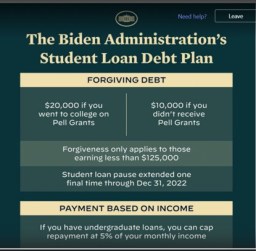
Although the White House and Secretary of Education have announced the creation of a program that will impact upwards of 813,000 MA residents, as I write this article (9/21/2022) we are still receiving guidelines piecemeal. What we do know is that borrowers with Federal Student Loan debt will be eligible for $10,000 ($20K if a Pell Grant recipient) based on income requirements. We have also learned that a separate Application will be required, available in mid-October and due by December 31, 2022. Adjustments to loan balances will be issued in early 2023. In the meantime, individuals who feel they may be eligible based ensure their account is up to date with their loan servicer and at www.studentaid.gov.
If you feel you are eligible under the PSLF provisions, file your application electronically now. There is a temporary limited PSLF Application deadline in place until 10/31/2022.
Note of Caution – DO NOT fall prey to the robocalling scam offerings. Their smooth-talking easy to handle service can lead one down the wrong path.
by Tom O'Hare | Sep 12, 2022 | College Admissions, College Planning, College Readiness, Financial Aid, Uncategorized
Are you rested and ready to get into the game?
Yes, fall sports are in full swing, but I am talking about planning for college.
Time to open up the playbook that will guide a family through the process of finding, selecting, applying, and financing college. September can be a busy month as students and families work to get back into the groove, and if working on the college planning process has been left to now, it’s time to scramble.
This month I’m dedicating my column to sharing information that families in 11th and 12th grades should be working on. Knowledge is power; The more you know, the less worry and stress a household will experience.
Every parent of a 12thgrade student going to college in September of 2023 should be finetuning their college planning checklist, identifying what’s completed, and focusing on what needs to be done in the coming weeks to meet deadlines for admission, scholarship, and financial aid.
- Budget and Costs – first and foremost, if a conversation about cost and affordability has not occurred, stop and have it! What will it cost, how much will we have to pay, and can we swing it, year one and beyond? Don’t finish the shopping experience without a budget number in mind – we can afford $$ on an annual basis. .
- Refining college choices – have you done the research, visited campuses, understand the who is a reach, highly probable for acceptance, or a so-called financial safety? What’s our best path – 4-years, community college, skilled training?
- Essay – is it in draft form or completed? Is it authentic, and will it captivate the reader? Grammar and spell check? A well-written essay can be the differentiator and catalyst for acceptance to college.
- Common Application – deadlines are approaching, what schools require answers to supplemental questions, when to pull the trigger to file, and should we will report test scores. Some of the many prep actions to get completed.
- Scholarships – is the hunt on? Many deadlines, especially national, statewide, and regional scholarships, are in the Fall. Don’t be fooled by the deadlines in the Spring, they usually only cover local awards given out at graduation. Download the Scholarship Workbook at Pivotal College Years to get a jump on the hunt.
- FAFSA – need-based financial aid is an important part of a family’s financing strategy. Completing and filing the Free Application for Student Aid is mandatory.. Resources from schools, Federal and State agencies, and philanthropic donors (scholarships) require the application. The window opens on October 1st.
- I’m I Known – most colleges do not know students are interested in them. Students need to be the recruiter, emailing, texting, and setting up a virtual meeting to introduce themselves, and their interests, obtain answers to questions and build relationships is critical. Don’t be shy!
- Credit Worthiness – Finally if a loan may be needed to finance the gap, the net cost to a family, don’t let one’s credit (co-signer) be a deal breaker. Act now!
Footnote to 12th-grade students not planning on going to college. Your 13th-year plan can also carry deadlines, applications, interviews, and mental and physical preparation (military) are a must as part of planning for the 13th year-you need a plan too. Whether your goal is to attend an apprenticeship to learn a skilled trade, enter the workforce, or serve our country, you too should have a plan.
11th Grade Checklist
It is not a clique when someone says this is the pivotal year. GPA, grades, academic progression, and demonstrating a commitment to activities in and out of school culminate at the end of the 11th Grade. The first semester of the 12th Grade is a bonus, but the magic happens in 11th Grade.
- Start Early – time is your enemy if you live with the hectic student and household schedules. The months turn quickly, and the clock even faster. Sports, dance, performing arts, volunteering, academics, and testing can overwhelm a student. Busy schedules can jam up the best of plans. October is the kick-off month with all students subscribing to take the National PSATs. Once test scores are returned, most 11th-grade families get the college planning bug.
- Building A List – but get it started – every student committed to attending college right after high school must pursue their own goals and aspirations, but with an eye on realistic expectations. Schools to consider will offer opportunities that challenge one academically and foster personal growth; yes, we can afford them! Start with crafting a broad list of colleges and universities based on a student’s high school resume/profile and initial preferences.
- Footnote: consider substituting academic interest when questioning majors, careers, and jobs when running these early lists. It is less intimidating for a student as many schools allow for the selection of a major after the first year.
- Need Academic Help – first marks tell the tale. Are grades from early tests on par or missing the mark? If so, consider bringing in an academic coach/tutor to supplement classroom and study skills work. Starting extra help in the 9th and 10th can bring even better results!
- Get Financially Prepared – understanding college costs and a successful financing strategy is equally important as good grades and a student character. Understanding what one can afford is essential to the college selection equation. Scholarships, grants, and federal loans won’t cover the entire cost of education. The gap may be small or large depending on the type of school, average aid awarded, and resources available from a family. Students and families should create a paying-for-college strategy, including determining their costs before shopping. Sounds like the senior year, maybe – but you have more time.
- Spring comes quickly – drafting a plan, learning the rules, and deadlines (scholarships, auditions, portfolio reviews), and prepping for when the snow melts will make for a successful experience.
College planning may not be considered exciting or sexy, but as the father of four and advisor to many, if you want to minimize stress and maintain harmony in a household, get a move on. Give us a ring or download a grade-level checklist (they begin for Middle School) at www.getcollegegoing.com Join our e-newsletter community, start a conversation or ask questions. No pitch or hock – just the facts.
Going the DIY path…. that’s OK too – consider subscribing to Pivotal College Years*. Designed as a digital portal, Pivotal offers guidance, tips, downloadable PDF documents, special topic workbooks, and more. Information, and assistance at one URL for families, before, during and after college. http://www.pivotalcolegeyears.com
Let the game begin!!
* Pivotal College Years is an affiliated partner of Get College Going.
by Tom O'Hare | Aug 16, 2022 | College Planning, Financial Aid
FAFSA TIME – 2023-2024 CHANGES
Leave it to Congress, the Administration, and the U.S. Department of Education to once again introduce changes to the Free Application for Student Aid (FAFSA).
Note: as we go to press, the DOE has not issued final regulations and guidance, so here is what we know today.
- Switch in Terminology – moving from the Expected Family Contribution (EFC) to the Student Aid Index (SAI). Methodologies are changing, and to the student’s (family) advantage, the result will be a calculation used by all providers to determine need-based aid.
- Who Files the Application – today, the parent(s) with whom the student lives 51% complete and file the FAFSA. Beginning with the 2023-2024 academic year (as of October 1, 2022), the parent(s) who claims the student as an exemption on their IRS Tax Return will be (new) required to complete the application. There will be no change for two-parent households; however, the change will have significant implications for divorced and separated families.
- Elimination of the Multiple Children – families with multiple students in college have received a break in their contribution. This provision ends with the 2023-2024 application. However, schools will be allowed to use their discretion to assist families.
- Untaxed Income – many areas have been redefined or excluded, including cash support and money paid on behalf of a student—the all-important help from grandparents and relatives.
- Note: Schools that require the CSS Profile will still be looking for this information.
- Income Protection Allowance – although the multiple children provision is gone, the percentage used to calculate adjustments to income has increased.
The Free Application for Student Aid (FAFSA) opens live for the 2023-2024 academic year on October 1, 2022. All students and families interested in applying for need-based financial aid awarded by colleges, universities, the federal, state, and even some private scholarship organizations should apply.
Keep in mind that the greatest factor in the determination of a student/family’s eligibility for need-based aid is income. For the 2023-2024 FAFSA the income reported will come from the 2021 IRS Tax Return. Real-time assets and savings play a role, but significantly less. The second is the school!
by Tom O'Hare | Jul 15, 2022 | College Admissions, College Planning, Financial Aid
We have reached the mid-point of the summer. We’ve been wearing our PFS 50, working, playing sports, walking trails, and enjoying outdoor dining at our favorite restaurant.
Like all processes in motion, keeping an eye on the college planning process is very important, even in the summer. Before you know we’ll be turning in our bathing suits for sweaters, and we’ll be in the thick of it. Take advantage of this time to make the Fall stress free.
TOP OF MIND
Tuition Bills – if the college tuition bill has not hit the mailbox, it will be there soon. The bill covers tuition, fee, campus housing, and meals for the first fall semester, with payments due by August. Before one can access their dorm, academic schedule, or meal plan, accounts for incoming or returning students must be resolved. Learn your resources, and put your financing strategy into action. Have questions; we’re here to share insights and best practices.
Add a copy of the Practical Funding Workbook from Pivotal College Years to your resource library.
Anxiety Before Departing – first-time and even returning college-bound students experience changes in their behavior leading up to the start of college. Modes, conversation, and temperament change. Experts stress the importance of keeping students focused on work, sports, friends, and summer hobbies while finetuning the process of hitting the campus. As parents, as excited as we are, it is important to avoid overselling the start or return to college. Watch, listen, and support – read more
2022 HS Seniors – Still Thinking – if going to college left you thinking of something different post-high school, you’re not alone. On average, up to twenty percent of a graduating class may not have been ready for college or had other plans. Work, defer a year, take on an apprenticeship position in a skilled profession, transfer, or take a few courses at the community college are all outstanding options. If you are unsure, cool, but have a plan on how and when to continue your learning! Need help sorting out the plan? Start a conversation.
10th – 11th and 12th-Grade Students – summer is a great time to explore colleges, participate in enrichment programs and plan for 2023, 2024, and 2025. Campuses may be in their off mode, but they’re open for business, tours, and a chance to speak with school representatives. Can’t get there, evaluate academics and campus life virtually and go in the Fall.
Examining financing strategies, drafting the essay, starting the application, and reviewing the checklist now. Use the time wisely and make the Fall stress free!!
Recent College Graduates – preparing for work and adjusting to life might include managing educational debt; federal and private loans are due to start repayment in November. It’s essential to learn one’s rights and responsibilities and investigate employer-sponsored benefits programs associated with your loan obligations.
by Tom O'Hare | May 10, 2022 | Before, College Planning, College Readiness, Financial Aid
The arrival of May 2022 has never been more needed than this year. Longer days and warmer days are upon us as we welcome back the likes of the Red Sox, summer sports, dance recitals, and getting the double-wide family trailer opened at the beach.
In households of soon-to-be graduating seniors, May 1 marked National Deposit Day, the day the Class of 2026 commits to enroll in college. Exciting for students and surreal for parents. The journey to find the right college to start one’s 13th year of learning and personal development is complete. All that’s left is finding a roommate, obtaining medical and legal documents, and finalizing how to pay. Congratulations to all.
If exploring higher education after high school is still being considered, maybe a different path is in order. No longer is it a one-education pathway that fits all. Exploring interests and options to achieve individual expectations and goals is the key.
May is equally important to current 11th-grade students on their threshold, 12-grade. College planning for juniors and even sophomores should be in high gear with scheduled campus visits. Campuses are alive with activities and opportunities. Schedule your on-campus visits now!!
To all the hard-working moms, thank you for your devotion and love. We celebrate you on Mother’s Day and every day!!
Congratulations – Graduation is in sight.
But, yes, there are a few more things for parents of college-bound students; one critical – is finalizing how to pay the remaining cost to attend.
- Step #1: Using the school’s financial aid award letter, calculate the net tuition price
- Cost – all merit and need-based aid awarded = the net tuition price
- Step #2: Review the financing options specific to your family’s resources – savings, gifts, investment earnings, home equity
- Step #3: Add to the help all external scholarships awarded at graduation or from external sources.
- Step #4: If a balance remains and no other resources are available, families can consider two credit-based loans, the Federal PLUS (Parent) Loan or an Alternative Private Education Loan (student is the borrower; parent is a co-signer).
- Access my Financing Worksheet, which walks you through the process.
Federal Education Loan Freeze
Once again, the U.S. Department of Education (ED), at the request of the Administration, has extended the student loan payment freeze to August 31, 2022. The extension suspends loan payments, drops the interest to 0%, and offers other benefits to delinquent and defaulted student loan borrowers.
While you wait for the thaw, borrowers with private education should investigate refinancing benefits: fixed interest rate, one account, or liquidating loans faster. It is unclear what the political air will be in September, so stay tone.
National Testing
The on-again, off-again debate goes on. SAT/ACT or not. The pandemic made it almost impossible for students to take the test; high schools stopped offering Test Day, resulting in a nationwide test-optional movement at colleges and universities. Many schools are rethinking their policies and reintroducing the requirement for admission and scholarship awards. What does this mean for 11th-grade students? If you can register and sit for the test, do so. BUT suppress releasing your results. Don’t take the free offer. Tipping one’s hat too early can be a barrier to acceptance!!
Don’t Wait …. Show Your Interest
Today, college-bound 11th-grade students need to introduce themselves and work to educated schools of their interests and academic and personal talents. It’s no secret that colleges and universities purchase students’ names and information. Part of their sophisticated enrollment management plans to target prospective students. But receiving an email or glossy brochure does not define a relationship. Using digital and traditional communication methods, students need to step forward, build relationships, and raise awareness about their interests. It’s critical in today’s college recruitment environment.
Planning Checklists
9th | 10th | 11th Grades
Five Steps to Planning and Financing
- Learn about costs – in/out of state, public or private, and community college.
- Determine what you can afford – get a pre-assessment of a family’s contribution and financial aid before going shopping.
- Learn how college makes their decisions, acceptances, waitlists, and financial aid awards
- Shop broadly – big, small, known, and unknown; avoid the trap of the rankings
- Create a comprehensive college plan to find the right education, at the right school for the right investment
College-Bound Seniors –
A few more essential tasks to address to ensure a smooth start to the academic year in September.
- Activate your NEW College Student email and ID
- Send in your Dorm Deposit & Find a Roommate
- Register and attend Orientation
- Complete Outstanding Forms (Meal Plan Selection, Campus Security Policy)
- Submit a Student Health Waiver (if the student is covered under a parent’s healthcare plan
- Submit the Family Educational Rights and Privacy Act (FERPA) Waiver (allows parents to retain their right to view student records after the student turns 18 years of age.
- Health/Immunization Records
- Submit AP/IB Test Scores (Credits)
- Take Placement Tests (if required) + Register for Classes
- Before leaving High School ensure your Final High School Transcript is sent
- Research extra-curricular on and around campus
- Work with your insurance carrier/agent if a car is going on campus
- Shop lightly; pack for the fall
- Enroll and be successful!

Partners Corner
Thoughts and Interests from Joanne Light – Parenting Empowerment Coach
Former Vice President of Enrollment Services, North Shore Community College
As parents, tweens, teens, and teachers contemplate a relief from pandemic issues and restrictions, they are also experiencing more stress. Stress is a result of uncertainty and anxiety and right now there is no shortage of causes of that. World unrest, school challenges, financial challenges, relationship challenges – all felt and seen.
However, personal stress is plaguing our tweens and teens in greater proportions. They are facing challenges and worries about identity, social interactions, academic pressure, and future unknowns. So since the world is unpredictable, let’s talk about stress management. First kids need to be aware of their stress and how it makes them physically feel – the racing heart, tightening chest, sweating, and mood changes.
Teenagers’ brains are fast developing, and the fight or flight part of their brain is producing hormones that lead to physical symptoms. They prepare to react to the “danger”. The rational part of their brain is not fully developed, so they may, unless in a calm state, overreact to the “danger” which may be an argument with a parent, an upcoming test, a slight by a friend, an unfinished college application, etc.
Some stress can be a good thing as it motivates planning, practicing, and resilience. Chronic stress, however, for your teen or for you is unsustainable.
There are choices for our kids in coping with their stress, and we parents can model stress management and guide them to make healthy choices. Talk to them openly about healthy vs unhealthy choices. Healthy choices will enable them to gain control and resolve their concerns and minimize some of the stress. The unhealthy choices – drugs, alcohol, poor eating, self-harm, risky sexual behavior, etc. only lead to poor academic performance, regrets, and lower self-esteem. And, of course, more stress.
I will be writing more to suggest creating stress management plans for your kids and for your family. Very important, however, is the example you set in managing your own stress.
Breathe, breathe, breathe…
Visit https://joannehlight.com/ to learn more
This is a new section where we will be featuring information from our colleagues and friends. Individuals who are outside of our lane, but linked through their wonderful work. Trusted partners.

WHAT WE’RE READING & WHO WE’RE FOLLOWING
Trends, changes, and things on the horizon
- Read about the pros and cons of taking a Gap Year. – Bottom line, have a PLAN Gap Year –
- Mental health issues on campuses are real – especially for student-athletes
- SAT changes are coming for 2024 – increased access, digital versus paper, shorter questions.
- New FAFSA rules and guidelines will affect 2023-2024, starting Oct 1
- Always good reading at Grown and Flown; Lessons to learn, conversations before going to college.
Events
College Planning Workshop – LIVE & In-Person – Free
Free workshop for parents of high school students
Topics to cover include
- How the pandemic has changed the way colleges evaluate and recruit students
- What not to do with retirement savings
- How to create a plan to find, select, and pay for school.
- There will be ample time for questions!!
Where: Wakefield Recreation Center
When – Two choices – May 17th and 25th from 7 PM to 8 PM
Sponsored by Pivotal College Years Register
SUMMER CLINICS
The PCY Workshop Series is now available! SMALL online classes with the experts. Topics covering Getting Started, Applications, Essays, and MORE…Register today! https://www.eventbrite.com/o/pivotal-college-years-15529534…


Check out the robust online library of information covering a wide range of topics, before, during, and after college. Resources include videos, PDF downloads, Workbooks – College Essays, Hunting for Scholarship, and other reference information on everything college. College Planning shouldn’t be complicated, intimidating, or expensive.
Use PCY30 for a free trial – Learn more
For you, your clients, and employees!
Get College Going
When you need that one-to-one support. We advise and guide parents; coach and counsel students. We’re industry experts and parents, just like many of you.
If you are feeling paralyzed or have a sense of anxiety, start a conversation – Follow us, and ask us questions
If you find our newsletter and information helpful, share it within your community and workplace.


Copyright © 2020 Get College Years All rights reserved.
Schedule a Free Consultation
617-240-7350
tom@getcollegegoing.com
