by Tom O'Hare | Jan 9, 2026 | College Admissions, College Planning, During & After - Just Thinking
I hope everyone had a wonderful holiday with family and friends.
As far as resolutions – don’t make them…..for me it’s all about:
- Getting to NC to visit my granddaughters more….
- Taking more walks on Long Sands Beach and at Nahant…
- Keep doing right for my students and families
- Sharing more education and knowledge on life after high school planning
- Keeping a diligent eye on the changing landscape of higher education
- Networking more, listening more, helping more
If you’re into making resolutions and still thinking, here is a good read on the subject.
Closer to home, in your home and business, a lot of excellent, wonderful, and exciting things are going to happen in 2026.
Here is what I am hearing, seeing, and learning to help ensure you have a successful year as parents, grandparents, and working adults.
- If you’re looking to borrow from the federal student aid programs to pay for college or career school, rules are changing on July 1, 2026: loan limits and program eligibility.
- Repaying your student loans will look different, especially for those who have not been paying since 2022. Tighter and less flexible repayment terms may cause many to fall into delinquency and default—rules of the game change on July 1, 2026.
- Hoping to stay away from the national testing scene, many colleges will be returning to their pre-COVID-19 admission requirements, including the reintroduction of national testing (SAT/ACT).
- Considering an elite, highly selective, sought-after college or university for 2027. Apply early. Over 2/3 of the Class of 2030 were taken from early applications, and upwards to 20% from the binding Early Decision applicant pool.
- Free and discounted tuition and fees will continue to be offered at community and private institutions for those who qualify. But legislative funding appropriations can throw a wrench into the 100% access for all.
- High schools, public, private, and charter, will grapple with an increased number of students and families leaving for homeschooling as families worry about the impact of budget cuts, safety, and bullying.
- Colleges and universities across the country will continue to eliminate underperforming, undersubscribed academic programs, resulting in reductions in staffing and faculty.
- The words skilled trades, community college, and non-degree credential programs will gain greater exposure and enrollment. Outstanding!! However, social pressures & the nature of higher education, it’s a business, will continue to promote the college for all mindset.
- Purchasing education after high school will remain expensive. Daunting for many…. Tackling the ‘how will we pay’ and ‘where should we go’ questions is critical. Answers we need before you fall in love with a dream college or get accepted and realize you can’t pay without depleting your retirement – Never – Never – Schedule a call with me 😊.
For Professionals, CEOs, CFOs, leaders in business and especially the financial services sector, your clients and workforce will be affected by these and other personal, emotional, and economic changes. Here’s what I see:
- Parents and young adults will be spending more time at work seeking answers to the questions causing them stress and anxiety day and night. Financial, health, family
- Productivity and general health for many will weaken as stress over tuition bills, loan repayment, and troubling college experiences for their students haunt their minds.
- More parents will consider delaying retirement contributions, while others will raid their retirement savings to pay for college.
- More families will ask grandparents to risk their golden years to cosign a private education loan.
- Parents with questionable or troubled credit profiles will scramble to find ways to pay for college as further limitations on federal student loan borrowing.
- Millions of borrowers will experience negative credit score hits, limiting or erasing access to consumer borrowing as the government catches up on student loan repayments after a six-year pause.
- Wage garnishment, bankruptcy, and lost SS benefits will return, affecting payroll and bank account deposits.
- Employees and clients will turn to you as their trusted employer and advisors for guidance. Please take a minute to prep your employee assistance programs and outreach services to ensure they offer a broad range of support. Schedule a call if I can help.
NO, I’m not starting 2026 with a negative lens. It’s laser-focused on these and other issues affecting families and individuals. I want 2026 to be better than 2025, for my children, grandchildren, you, and yours!
If I have hit a cord at home or work, let’s start 2026 on a positive note!!
Everything begins with a conversation – schedule a no-obligation time to talk at www.calendly.com/tom-126 or call 617-240-7350.
by Tom O'Hare | Nov 5, 2025 | College Planning, During & After - Just Thinking
What Does Thanksgiving Mean to ME?
Turkey, mashed and sweet potatoes, and stuffing? High school football games? A house full of energy and happiness.
T-Day is a time to take stock and give thanks for our blessings, gifts, and those in our lives. Wishing everyone joy and excitement, not just on Thanksgiving, but every day throughout the year.
Thanksgiving is the first significant break in the action for college and career students, especially first-year students who return home having left in September. The first time for a brief, but extended break. As the father of four, the break was always an interesting time for them, with their new dynamics and my desire to learn everything about their academics and campus life.
As parents we’re anxious to learn everything, while students are interested in the three R’s: refueling, reconnecting, and recharging their batteries. They can be talkative or quiet.. Don’t despair, just be patient..
Remember, they’re on break when you pick them up. I recall how challenging it was to resist asking them about their classes, friends, and activities. Most rides quickly became quiet as they fell asleep (three out of four), and I listened to smooth jazz.
The moment will come to ask questions and dig into how campus life is going—and whether there are potential bumps in the road. As parents, we must listen for signs and be patient. Please send them to the T-Day football game and feed them. Then, inquire about the first semester. If they’re struggling, let them know it’s normal, but encourage them to consult with academic support and resident life, and to explore options for joining a club or organization to get involved. Thanksgiving is a bit past the midpoint of the semester. Your student has three weeks to “crush it” before the end of the semester and Christmas break. Address things now.
My colleague, Mya Anderson from Student Empowered, shares other important tips and ideas to support your 1st year student home for the holidays.
For high school students and their families, Thanksgiving marks a significant milestone in the college planning calendar:
- By now, seniors (families) should have submitted 99% of their admission applications and the FAFSA (and maybe the CSS Profile). Their eyes should be on college portals and emails for information, as well as on scholarships.
- If students are undecided, the break can be a perfect time to discuss the next steps. No one path after high school fits everyone, even if that’s what you hear (feel). Work, community college, service, apprenticeship, and a structured gap year are all effective options.
- Juniors (and 10th graders), it’s time to turn up the heat on your college planning, including creating a resume, thinking about living in a dorm, and how big is too big (campus), and where do you draw the line on distance from home. Come January, you’re building a list, learning how to evaluate options, and figuring out where to visit during the February school break.
- Upper-class college students need to focus on checking their timelines and credit requirements to graduate on time. Enrollment timelines for five- and six-year-olds are very expensive.
- Graduated or graduating soon, it is time to plan as student loan grace periods are about to expire and loan repayment begins on Federal and private education loans.
- Parents, yes, there is a lot to talk about as you continue to coach and guide your high school-, college-age, and working young adults.
Thanksgiving break is an exciting and busy period, but it’s also a time to stay ahead of pressing deadlines and tasks.
Wishing all a very Happy Thanksgiving.
by Tom O'Hare | Aug 19, 2025 | College Planning, During & After - Just Thinking
Thoughts from a first-year college student on their way to year two.
Recently, I spoke with a group of students who have just completed their first year of college. We discussed their experiences, challenges, and the advice they would give to themselves as they entered for the 1st time. Their stories, which were filed with lessons learned, are shared below.
Who are they, you ask? My students were from a diverse group. Their schools are close to home, two hours away, and one arrived by plane. They enrolled in medium-sized (5K), large (10K), and those with 20+K students. They’re pursuing various academic interests; some are dancing, and others are playing DII, DIII, and club sports. Like you, their diversity is reflected in the experiences they brought to their college.
Things to consider as you embark on this exciting next stage of your education and personal growth. Here are the top 10 comments:
#1. Get out of your dorm. A dorm room is for sleeping, unwinding, and relaxing with friends and roommates. But they ALL wholeheartedly stated that they needed to leave their dorms to study. Find a quiet & calm place to study away from the dorm. Library, tech center, or the academic center.
#2 New friends are not all in the dorm. Outside of your roommate/floor mates and neighbors, all agreed they met more friends outside the residence hall. They joined a club or two, got involved with intramurals, and attended events. One will enter her sophomore year with a new roommate, in a new dorm, after being involved in a civic organization.
#3 College academics— again, a 100% acknowledgement that classes and faculty at the college level were harder than anticipated. Whether high school was a breeze or one spent long hours studying, the first semester was rough. There was a lot of reading and taking notes, and the faculty expected you to do the work, develop good study habits, and stay on top of work. There was no handholding.
#4 Get to the Academic Center early. Two of the rising Sophomores waited until the end of the semester to see out help—not their best move. Collectively, they all mentioned that their expectation of getting A’s, like in high school, became the reality of B’s and C’s. See the faculty during their office hours, and don’t hesitate to sign up for help at the Academic Center. Do not procrastinate.
#5 Lonely 1st week – then it rubs off after getting involved on campus. Everyone was homesick initially, but all acknowledged that they learned they could be independent.
#6 Read your emails—Events, messages from faculty, assignments, deadlines, and more are communicated through emails and the student portal.
#7 Less is More – Everyone agreed; they took too much stuff to campus and sent most of it home.
#8 Be healthy—exercise, eat right, hydrate, get enough sleep, and watch out for free time. Check in at home periodically; they want to know how you are doing.
# 9 Use an Alarm Clock—you can sleep late on weekends. Faculty hate students who come to class late!
# 10 Communicate with Parents—agree on a method (text, email, call) and schedule a time to check in at home periodically; they want to know how you are doing.
Remember, students and families are consumers of a post-secondary education. Advocate for your needs, use your resources on campus and back home, and if need be, text me.
by Tom O'Hare | Jun 30, 2025 | During & After - Just Thinking, Student Loan Repayment
Should I refinance my education loans?
Refinancing your college loans is a significant financial decision that can save you money, but it’s not the right choice for everyone. Here’s a breakdown of factors to consider to help you decide:
Reasons to consider refinancing:
- Lower interest rate: If you can qualify for a lower interest rate than your current loans, you can save thousands of dollars over the life of the loan.
- Improve credit score: A good credit score can lead to lower refinance interest rates. Refinancing could be beneficial if your credit has improved since you took out your original loans.
- Simplify payments: Refinancing allows you to consolidate multiple loans into a new loan with one monthly payment.
- Switch to a Fixed Rate: Refinancing to a fixed-rate loan can provide more predictability if you have a variable interest rate loan and are concerned about the rate increasing.
- Removing a Co-signer: Most loans carry a co-signer release of 24-36 months based on eligibility. If eligible, removing a co-signer from the note earlier can benefit the co-signer’s credit and ability to borrow.
- Pay off debt faster: A lower interest rate can allow you to put more money towards the principal balance, enabling you to pay off your debt sooner.
- Steady income: Lenders will evaluate your income and debt-to-income ratio to ensure you can afford the new loan. A steady income can increase your chances of being approved and getting a good rate.
- No need for federal loan protections: Refinancing may be a good option if you don’t require the flexibility and protections offered by federal loans, such as income-driven repayment or forbearance.
When refinancing may not be the best option:
- Federal loan benefits: Refinancing federal student loans with a private lender means losing access to federal protections and benefits like income-driven repayment plans, loan forgiveness programs (e.g., Public Service Loan Forgiveness), deferment, and forbearance options.
- High-interest rate: Refinancing might not be worthwhile if you cannot secure a lower interest rate than your current one.
- Bankruptcy or default: If you have recently defaulted on loans or declared bankruptcy, you will unlikely qualify for refinancing.
- Fees outweigh savings: For borrowers with low loan balances, the cost of fees associated with refinancing may outweigh the interest savings.
- Unstable income: If your income is unpredictable, it’s best to stick with federal loans, as they offer more flexible repayment options.
- Pursuing loan forgiveness: Refinancing will make you ineligible if you pursue a federal loan forgiveness program.
In summary:
Refinancing can be smart if you can secure a lower interest rate, have a stable financial situation, and don’t require the protections offered by federal student loans. However, it’s crucial to carefully consider the potential loss of federal benefits and assess your circumstances before deciding.
To make an informed decision:
- Prequalify with multiple lenders: Compare rates and terms that different refinance companies offer.
- Use a student loan refinancing calculator: Estimate your potential savings based on different interest rates and repayment terms.
- Evaluate your financial situation: Consider your credit score, income, and overall debt levels.
- Understand the trade-offs: Weigh the benefits of a lower interest rate against the loss of federal loan protections.
By carefully evaluating these factors, you can determine if refinancing is the best way to manage your college loans effectively.
Call use at Get College Going. Were happy to review best practice options for you and make recommendations on a ender or credit union.
by Tom O'Hare | Jun 15, 2023 | College Planning, During & After - Just Thinking, Financial Aid
Congratulations, Class of 2023
WOW – To the students and the parents of the graduating Class 2023 – WOW
Kindergarten, elementary, middle, high school, college, and graduate students – Congratulation!
It is time to pause, recharge and refuel. But let’s not hit the pause button for too long.
No summer sliding unless it is down the famous slip-and-slide in the yard.
Whether moving up a grade, to a new location, taking on an internship or apprenticeship, or joining the workforce, use the summer to champion forward. The Route One family is here to help!!
Exciting News!
We are thrilled to announce the release of our latest book, the “Pivotal College Planning Workbook,” now available on Amazon!
Unlock the secrets to successful college admissions by discovering valuable tips on your college search, securing funding, insights into financial aid, and more. Order your “Workable Workbook” today – available on Amazon now: https://amzn.to/3NG0BX7

Summer Checklist
Protecting Your Student and Family
In the eyes of the legal and medical world, when a student turns eighteen years of age, they’re an adult. Yes, we will always consider them our little kids, but it is important to put the correct documents in place to continue advocating and supporting them. Review and put in place safeguards before they leave home-
- HIPPA Agreement (medical)
- Durable Power of Attorney (legal)
- Liability Insurance (financial), and
- FERPA Waiver (college).
Speak with a professional to protect your student and family.
Summer Assignment – Read and Explore
Reading is fundamental. It improves English, writing skills, and vocab. In my private counseling practice, I ask all students to spend time reading during the summer. One novel a month. If sharpening academic skills, study habits, and testing prep is needed, consider introducing a tutor to the summer schedule.
For families of 10th and 11th grade students use the summer to pop on to a college campus. Check out a large, small, city or one located in a town. Students who have never seen or been on a campus will benefit from a brief (not a tour) look at what might be in their future.
Scholarship Employment
Working during the summer is important for high school or college-age students. It provides valuable spending money when returning to school. But there is an equally important summer job, a Scholarship Searcher. Committing time during the summer to research, identify, and create a database of eligible scholarships is an important job for rising seniors, 11th and 10th grade families. Its reported that hundreds of scholarship with Fall application deadlines are left in the money room. Obtain a copy of your Scholarship Workbook, how to be a scholarship searcher by subscribing to Pivotal College Years.com. Don’t wait till the Fall to learn you missed a valuable financial resource.
Rising Seniors
Get ahead of the Fall. Spend time on critical assignments to make the senior year enjoyable. If you’re college-bound, focus on four critical tasks:
Drafting your Essay
Completing the Profile Section of the Common Application
Narrowing your college options
Engaging your College Representatives
If your path after high school will lead in a different direction, don’t delay. Your planning process needs attention too. Whether it will be a skilled apprenticeships, work, or services, use the summer to map out your post high school pathway.
.Parents – your task is to determine your college financing strategy, and it is not just about your family resources. Where you apply is equally, if not more, important!
Right Around the Corner -Repaying Federal Education Loan
The end is nearing pandemic freeze on the repayment of Federal Student Loans is over. Repayment is set to restart in September, with the first payment due in October. It is time to dust off your Student Aid ID and PW to check your loan details and determine the next steps. Regular monthly payments, applying for an Income-driven repayment program (IDR), or Public Service Forgiveness Program (PSLF), and refamiliarizing yourself with your loan servicer. Consult the Federal Student Aid website to learn more https://studentaid.gov/
Education loan refinancing and modified repayment may be an option for a family whose budget has continued to experience financial strain.
Employer-sponsored education programs is no longer just tutition reimbursement. Today companies are offering employees services to help with student loan repayment, managing education debt, financial literacy and even colege planning advising. Consult with your companies HR department or associations employee benefits provider.
Consult an Independent Education Advisor
Need help with your checklist, calming the waters, managing education loan repayment, or hosting an onsite employee education and enrichment session? Consider speaking with an experienced Independent Education Advisor. Get College Going, a North Shore-based full-service education advising practice, has been helping families for four decadents through its extensive resources and expertise before, during, and after college. Visit www.getcollegegoing.com to schedule a conversation.
by Tom O'Hare | Oct 9, 2022 | College Admissions, During & After - Just Thinking, Financial Aid
October is a month when a lot of things begin to happen. We welcome the arrival of crisp air, pumpkins, and earlier sunsets in the Fall. I look forward to Halloween, football under the lights, college fairs, and adding a vest to break the chill.
For families of high school students, especially those in 11th grade, October ushers in the thought of planning for post-high school, the 13th year. College, work, apprenticeship, or a combination. Twelve-grade families, it is an all-hands-on-deck push to complete applications, admission, and financial aid with an eye on September of 2023. For parents of college-age students, October is a time to check in on first marks and adjustments to being away.
Last month I took you into the weeds of this important to the college planning process. This month we’re looking at dates, deadlines, and events on the October calendar.
DATES
Wednesday, October 12th – PSAT Test Day
The preliminary SAT and National Merit Scholarship Qualifying Test (PSAT/NMSQT) is administered nationally on one Wednesday in October. High schools work with the College Board to administer the test in Massachusetts and across the six-state region. Scanning a sampling of MA, NH, and ME high schools, students will take the PSAT on Wednesday, October 12. All students are encouraged to take the test to set a benchmark for future testing and as a qualifier for the National Merit Scholarship. Check with your high school to confirm the date for your school system. Homeschooling families are eligible to sit for the test at the town/city high school. Note: Saturday, October 15th is an alternative date
Saturday, October 1 – FAFSA Application Opens
The Free Application for Student Aid (FAFSA) is the universal application that ALL students and families considering attending or returning in September of 2023 must file to be eligible for need-based financial aid. Whether a student is considering undergraduate, graduate, a 4YR college or university, Community College, or a qualified trade and professional school, completing and filing the FAFSA is a must. We have published a FAFSA Checklist outlining the steps to take and the information required to complete the application in the Resource section of our website. It only takes 45 minutes to complete – Don’t leave valuable financial aid on the table.
Download a copy of the 2023-2024 FAFSA Checklist get started.
November 1st | 5th | 15th – Early Action Application Deadlines
Students planning on submitting their application for admissions using the Early Action timeline should be working to gather all necessary documentation to meet the deadline. Check with your specific college for admission requirements and dates. Be aware, I am not an Early Decision advisor. It limits choice and technically is a binding agreement process. Early action accomplishes the same, early consideration but without the stress of a binding agreement. Regular admission deadlines are in January and February. To be ready, you need:
⊗ Fully Loaded Application – the Common Application or school specific app
⊗ Dashboard loaded with school choices
⊗ Authentic well written essay
⊗ Responses to school specific Supplemental Writing (Questions)
⊗ Recommendations
⊗ High School Resume (if wishing to upload)
⊗ Fee Waiver – if eligible
⊗ Credit Card – pay the fee
EVENTS
High School College Fairs
Meeting and speaking with a college Admission Representative is an important experience for all high school students and their families, especially those in 11th grade. When you can’t get to a college to take a tour or meet on campus with an Admission Counselor, attending a College Fair is a great alternative. Representatives participate in local high school mini-fairs or regional events throughout the Fall. Students should listen to daily announcements or check the Guidance Department’s website to learn who & when are colleges coming to the school. Learn more about virtual fairs sponsored by NACAC
College Open House
High school seniors and families working to narrow their college selection should consider attending an Open House. Schools that are on the top of the list or not yet visited are prime choices. Need help narrowing the list, attend an Open House. Open House events are typically held on Saturdays and they are all-hands-on-deck events. You’ll have a chance to meet and speak with school administrators, faculty, and coaching staff, attend seminars, visit classrooms and speak with students. Check the college website for dates and times.
Family (Parent) Weekend
First-year and returning college-age students have been on campus for more than 30 days. Parents of newly anointed college students will find attending their student’s Family (Parent) Weekend event helpful. A weekend devoted to helping parents learn more about what their student is experiencing and the role they can play in helping their student be successful. As the dad of four, my wife and I always enjoyed attending these events with our younger students. We connected with other parents, listened for clues as to how our student was doing, and of course, went to dinner. Check the college website for dates and times.
TOP OF MIND
Loan Debt Forgiveness and PSLF Program
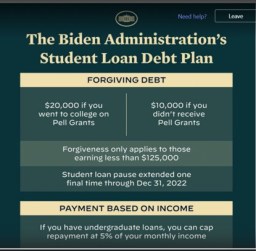
Although the White House and Secretary of Education have announced the creation of a program that will impact upwards of 813,000 MA residents, as I write this article (9/21/2022) we are still receiving guidelines piecemeal. What we do know is that borrowers with Federal Student Loan debt will be eligible for $10,000 ($20K if a Pell Grant recipient) based on income requirements. We have also learned that a separate Application will be required, available in mid-October and due by December 31, 2022. Adjustments to loan balances will be issued in early 2023. In the meantime, individuals who feel they may be eligible based ensure their account is up to date with their loan servicer and at www.studentaid.gov.
If you feel you are eligible under the PSLF provisions, file your application electronically now. There is a temporary limited PSLF Application deadline in place until 10/31/2022.
Note of Caution – DO NOT fall prey to the robocalling scam offerings. Their smooth-talking easy to handle service can lead one down the wrong path.